Is Tesla Overvalued in 2026? The Simple Answer, Explained
A plain-English look at whether Tesla's $1.5 trillion price actually makes sense — no finance degree needed.
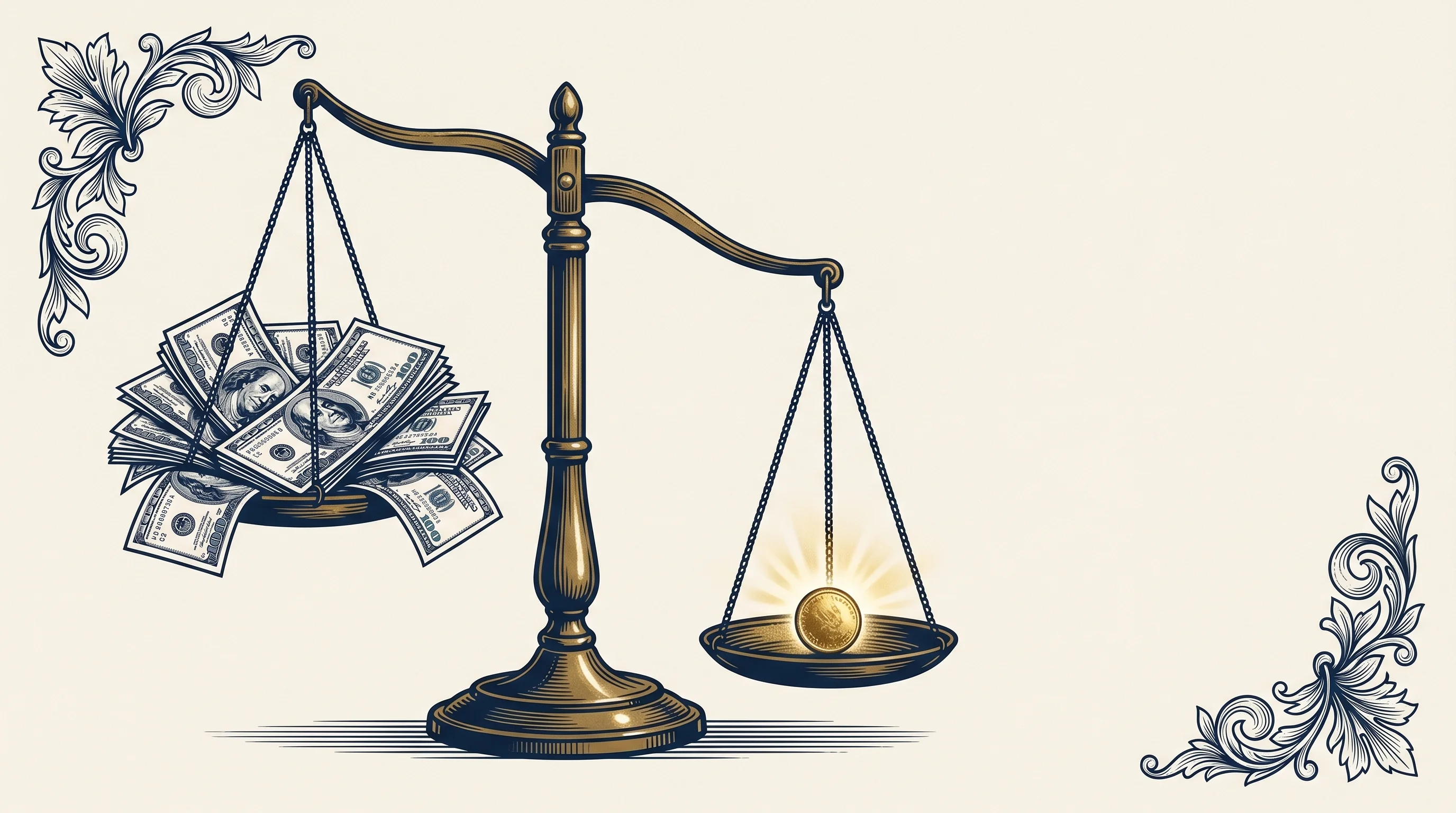
Short answer: yes, by almost every normal measure, Tesla is overvalued at $435 a share. The longer answer — why so many smart people still buy it anyway — is more useful. Let's walk through it in plain English.
Tesla is the most-debated stock in retail investing. Bulls think it's the next Apple, the next Amazon, and the next OpenAI all in one. Bears think it's a car company trading at four hundred times earnings with shrinking margins. Both sides have honest arguments. Most of what you read online is not analysis, though — it's tribe.
This guide is the simple version of the question is Tesla overvalued. No finance degree needed. We will look at Tesla's actual numbers, compare them to the price, do one easy back-of-the-envelope calculation, and tell you exactly what you'd have to believe to make $435 reasonable.
What "overvalued" actually means (and why is Tesla overvalued matters)
A stock is overvalued when the price you pay today is higher than what the underlying business is reasonably worth. The "underlying business" means the actual company — its sales, its profits, the cash it generates each year. Not the chart. Not Elon's tweets. Not the latest robotaxi promise.
Two simple ways to think about value:
- Earnings yield. The company earns $1 per share. You pay $20 for it. You bought $1 of yearly earnings for $20. Your return on earnings is 5 percent. Think of it like the interest rate on a savings bond.
- Cash return. Imagine you owned the whole company. How much cash could you take home each year? Divide that by the company's total price tag. You get a yearly return — comparable to the interest rate on a savings account.
A stock is fairly priced when these returns at least match a safe US Treasury bond. It is overvalued when they are noticeably worse. The only excuse is a strong reason to believe the cash will grow much, much bigger in the future.
That's the whole framework. The question is Tesla overvalued is much easier once you have it.
Tesla's numbers in plain language
Here are Tesla's actual numbers from its most recent annual filing — the year ending December 31, 2025.1
| What | How much |
|---|---|
| Total sales (revenue) | $94.83B |
| Profit (net income) | $3.79B |
| Profit margin | About 4 cents of every dollar of sales |
| Cash the business actually kept | About $6.22B |
| Money it spent on new equipment | $8.53B |
| Number of shares outstanding | 3.54 billion |
| Current share price | $435.79 |
| Total market value of all shares | About $1.54 trillion |
To put $1.54 trillion in perspective: it's roughly equal to the entire annual economy of Spain. The market is saying every claim on Tesla's future cash, today, is worth more than what a major European country produces in a year.
Two numbers in that table do most of the work for whether Tesla is overvalued.
The first is the 4 percent profit margin. Toyota, the most successful car maker in history, runs around 8-10 percent. Tesla makes less profit per dollar of sales than Toyota does — and Tesla is supposed to be the tech company.
The second is the 0.4 percent cash return. That's $6.22B in cash, divided by the $1.54 trillion market value, times 100. It is the yearly cash return you'd get if you owned all of Tesla today. A boring US government bond pays 4.5 percent. You are accepting roughly one-tenth the return of a risk-free bond, in exchange for stock-market risk.
That only makes sense if you believe Tesla's cash will grow to many times its current level. The whole answer to is Tesla overvalued turns on whether you believe it.
The simple "what is it worth" calculation that shows is Tesla overvalued
There is a classic, easy way to estimate what a business is worth based on the cash it generates. It is called the Gordon growth model — fancy name for a simple formula:
Fair value per share = (cash per share next year) ÷ (return you'd want − growth rate)
For Tesla, three inputs:
- Cash per share = $6.22B ÷ 3.54B shares = $1.76
- Return you'd want = 10 percent. A reasonable target for a single-stock position.
- Long-run growth rate = 4 percent. About the limit of what any company can grow forever — the US economy grows at around 4 percent in nominal terms.
Plugging it in:
Fair value = $1.76 × 1.04 ÷ (0.10 − 0.04) = $30.51
The conservative "what is Tesla worth" answer is about $30 per share. Tesla trades at $435. By this simple test, yes, Tesla is overvalued. By a lot.
That doesn't mean Tesla is going to fall to $30. It means the market has decided the conservative numbers are wrong, and is pricing in dramatic future growth.
How dramatic? Here's the same calculation with different assumptions:
| Required return ↓ / Long-run growth → | 4% | 6% | 8% |
|---|---|---|---|
| 8% | $46 | $93 | breaks* |
| 10% | $31 | $47 | $95 |
| 12% | $23 | $31 | $48 |
*The formula stops working when growth equals or exceeds your required return. The fact that justifying Tesla's price requires growth assumptions that approach this breakdown is the warning sign.
To justify $435 with this kind of calculation, you need to plug in growth at near the discount rate — meaning the company keeps growing nearly as fast as your required return, forever. That is what Tesla bulls believe future projects (full self-driving, robotaxi, Optimus) will deliver. It is also mathematically problematic — economies do not sustain that kind of growth indefinitely.
Why someone reasonable might still own Tesla anyway, even if it is overvalued
Saying Tesla is overvalued by traditional measures is not the same as saying you should never own it. The question of is Tesla overvalued and the question of "should I own it anyway?" are not the same. Smart investors disagree on Tesla for honest reasons.
The case for owning Tesla at $435 rests on four ideas:
- The car business is not the point. Tesla is funding three potential new businesses: full self-driving as a subscription, robotaxi as a transportation service, and Optimus as a humanoid robot. Any one could be a $100B+ revenue line.
- Vertical integration is real. Tesla makes its own batteries, motors, software, and AI chips. That mix of in-house capabilities is hard for any competitor to match.
- The data lead in vision-based AI is unique. Tesla has millions of cars feeding driving data back to its training systems. If autonomy turns on data scale, Tesla starts ahead.
- Growth-rich businesses look overvalued right before they grow into the price. Amazon looked obviously overvalued in 1999, 2002, 2008, 2014, and 2020. Investors who held through anyway compounded enormously.
The case against owning Tesla at $435 is the opposite of each:
- The car business is the business. Future projects have been "next year" for a decade. FSD has missed every deadline. Robotaxi has slipped repeatedly. Optimus is a demo, not a product. If they don't deliver, you're left with a car company at 400× earnings.
- Chinese manufacturers have closed the cost gap. BYD, Xiaomi, and Li Auto are competitive on price and increasingly on technology. The vertical-integration moat is narrower than it was.
- Data without autonomy is just storage. Waymo, Mobileye, and several Chinese OEMs have competitive autonomy programs. Tesla's data lead does not guarantee winning.
- Some stocks really were overvalued at their peak. Cisco was the AI darling of 2000. Its stock fell 80 percent and never recovered. The math is not always wrong.
Both sides have intellectually honest people. Either could be right.
So, is Tesla overvalued at $435?
The honest answer: by every conservative measure of value, yes, Tesla is overvalued. The cash yield is well below a Treasury bond. The simple "what is it worth" calculation gives $30 against a $435 price. To make the math work, you need to plug in growth assumptions at the edge of mathematical defensibility.
That does not mean the stock will fall tomorrow. It means buying Tesla today is buying a story about three specific future products — FSD, robotaxi, Optimus — not a discount to current cash. If any one of those delivers spectacularly, you do well. If none of them deliver in the next five years, the math eventually catches up with the price.
The single test that will tell you who is right over time:
- Does FSD become a real subscription revenue line above $5 billion per year before end of 2027?
- Does a Tesla robotaxi service launch in any major US city with regulatory approval before end of 2026?
- Does Tesla's operating margin return above 12 percent within the next 24 months?
If two of three fail, the bear case is winning. If two of three deliver, the bull case is winning. Watch those specific milestones. Decide based on what you actually see, not on what anyone on social media is telling you. The question of is Tesla overvalued will answer itself in those numbers within three years.
Related reading
For the bull-case framing on the same stock, see our companion piece Is Tesla Stock a Buy?. For comparison reads on the other AI-era stock with extreme valuation, see Is Nvidia Overvalued? and Is NVDA Stock a Buy?. For the underlying methods, the margin of safety formula covers what to do once you have a fair-value estimate, the owner earnings formula is the more careful way to calculate cash flow than what we used above, and the DCF valuation guide walks through the full version of the Gordon-growth math.
For more long-form essays on plain-English stock valuation, see the rest of the Hub.
Tesla, Inc., Annual Report on Form 10-K for the fiscal year ended December 31, 2025, filed January 29, 2026 (SEC accession 0001628280-26-003952). Revenue, net income, operating cash flow, capital-expenditure figures (PaymentsToAcquirePropertyPlantAndEquipment) are all from this filing. Share count from the subsequent quarterly report. ↩