Economic Moat: Buffett's Five Types and How to Spot One
What an economic moat actually is, the five types Morningstar codified, and how to verify one from a 10-K — with Visa as a worked example.
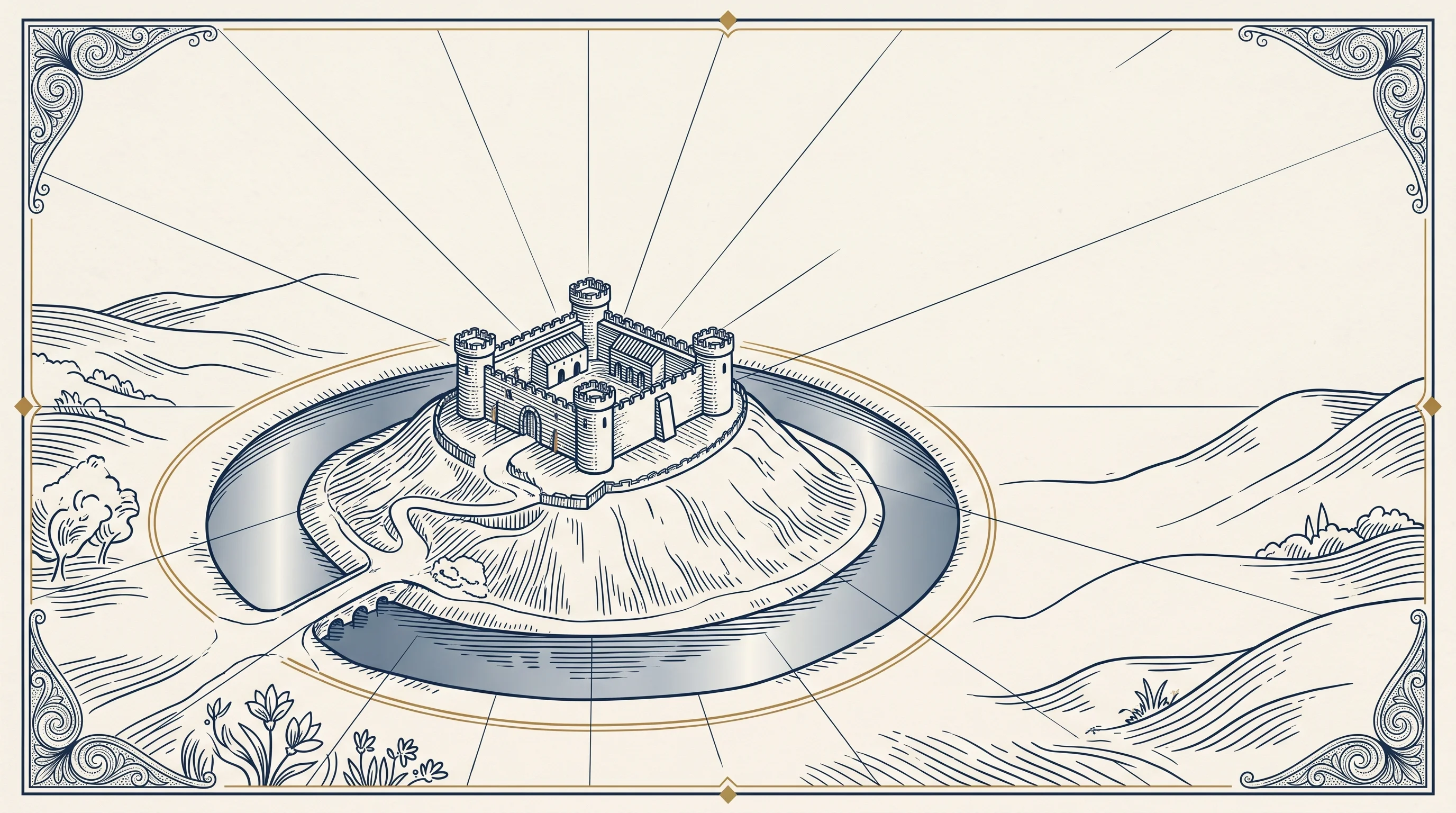
The single most-borrowed metaphor in modern investing is Warren Buffett's economic moat. It refers to the durable competitive advantage that protects a business from the competitive forces that erode the profits of ordinary companies over time. Buffett's framing is intuitive enough that almost every investor can quote it. Far fewer can answer the harder question. Given a specific company, how do you verify it actually has an economic moat?
This essay is the long version of how to do that. Where the metaphor came from. The five types of economic moat that Morningstar codified into a systematic framework. The three financial signatures that distinguish a real moat from a temporary lead. And a worked example using Visa's 2025 annual filing — a business whose moat is so visible it shows up directly in the operating margin.
The reason the moat question matters is simple. If you cannot identify a durable competitive advantage, your forecast of the company's owner earnings five or ten years out is fantasy. Every long-term valuation model rests on a growth assumption. That assumption only holds if the business can defend its returns from competitors. The margin of safety formula, the owner earnings calculation, and any flavor of DCF all share this dependency. The moat is what makes the growth term in those formulas honest.
What Buffett actually said about economic moats
The metaphor appears across multiple Berkshire shareholder letters and a famous 1999 Fortune interview. The formulation Buffett used most often is straightforward:1
"The key to investing is not assessing how much an industry is going to affect society, or how much it will grow, but rather determining the competitive advantage of any given company and, above all, the durability of that advantage. The products or services that have wide, sustainable moats around them are the ones that deliver rewards to investors."
Two words in that sentence do the work: wide and sustainable. A wide moat is one that gives the business meaningful pricing power or cost advantage today. A sustainable moat is one that will still exist in ten years. Both are needed. A wide-but-eroding moat is a value trap; a narrow-but-durable moat may still produce attractive long-term returns if the price reflects it.
This is the framing the rest of the essay operates inside. We are not asking "does this company make money today?". We are asking "will this company still be earning above its cost of capital in ten years, and what specifically is preventing competition from arbitraging that gap away?".
The five types of economic moat
Buffett never gave a typology. The Morningstar equity research team, led by Pat Dorsey and later by Heather Brilliant and Elizabeth Collins, did the work of codifying one. Their published methodology recognizes five types of economic moat, and almost every durable competitive advantage you can name maps to one (or sometimes two) of these.2
Intangible assets
Brands that command pricing power, patents that block direct competition, regulatory licenses that limit entry. The classic examples are Coca-Cola's brand (consumers pay a premium for the red can rather than a generic cola), pharmaceutical patents (Pfizer's drug exclusivity periods), and ratings agencies (Moody's three-firm oligopoly is regulatory).
The test for an intangible-asset moat is pricing power. Can the company raise prices in line with or above inflation without losing volume? If yes, the brand is doing real economic work. If price increases come with measurable share loss, the brand is more decoration than moat.
Switching costs
The cost — in money, time, training, or operational risk — of moving from one supplier to another. The textbook examples are enterprise software, bank checking accounts, and medical devices. Replacing an installed Oracle database or SAP ERP costs millions and takes years. Moving direct deposits and bill pay between bank accounts is friction most customers never bother with. A hospital that has trained its surgical team on one company's equipment will not switch lightly.
Switching costs are the most underrated moat type. They often look like brand loyalty in the income statement, but operate through a different mechanism — they raise the cost of leaving, not the willingness to stay.
Network effect
Each new participant on a platform makes the platform more valuable to every other participant. Visa and Mastercard are the canonical example: more cardholders mean more merchants accept the card, which means more cardholders sign up, which means more merchants. LinkedIn benefits from the same dynamic on the professional side; Airbnb on the marketplace side.
A network effect moat compounds. Once one platform reaches sufficient scale, displacing it requires a competitor to deliver both sides of the market simultaneously — a far harder problem than building a better product.
Cost advantage
A sustainable structural cost advantage that competitors cannot easily replicate. Costco's scale and membership model produces a per-unit cost structure no smaller retailer can match. Geico's direct-distribution model removes the agent layer of traditional auto insurance, producing a five-to-seven-percentage-point cost advantage Berkshire has been writing about for forty years. Walmart's logistics network is a third example.
The key word is sustainable. A cost advantage that disappears at competitor scale (Amazon underpricing books in the early 2000s) is not a moat. A cost advantage rooted in network effects, geography, or scale efficiencies that competitors cannot reach is.
Efficient scale
A niche market large enough to support one or two profitable players but not three. Regional pipeline operators, ratings agencies, and certain industrial distribution businesses fit here. The signal is a small, defined market. The incumbent has rational reasons not to over-invest because doing so would destroy returns. Entrants have rational reasons not to enter — the existing operator will fight, and the market is too small for two.
Efficient scale is the most fragile of the five moat types. Markets grow, regulations change, technology shifts the cost curve. Where it holds, though, it produces returns far above cost of capital for decades.
How to verify an economic moat from the 10-K
The five types above tell you what to look for qualitatively. The financial statements tell you whether the moat exists quantitatively. There are three signatures that distinguish a real economic moat from a temporary lead. All three should hold over a multi-year window — a single good year proves nothing.
1. Sustained high return on invested capital. A moat-protected business earns returns well above its cost of capital — typically 15 percent or higher. The number must be sustained over a full economic cycle. ROIC = NOPAT ÷ (debt + equity). One good year of 30 percent ROIC is not a moat. A ten-year average of 25 percent is.
2. Stable or expanding gross margin. A moat lets a company hold or grow its margins under competitive pressure. Watch the trajectory, not the single number. A gross margin that holds at 60 percent for a decade while competitors compress is a moat in plain sight. A gross margin that compresses 200 basis points per year is competition winning the argument.
3. Low capital intensity relative to revenue growth. Capex as a percentage of revenue tells you how much new investment the business needs to grow. A low ratio with strong revenue growth means the existing assets are doing the work — the moat is producing operating leverage. A high ratio means the company is buying its growth.
Read each signature against the financial statements as you go. For a walk-through of which sections of the 10-K to read first when verifying these, see our working investor's guide to the 10-K.
A worked example: verifying Visa's economic moat from FY2025
Visa's fiscal-year 2025 annual report covers the year ended September 30, 2025, and was filed with the SEC on November 6, 2025.3 Let me run the three financial signatures.
| Visa FY2025 line item | Value |
|---|---|
| Net revenue | $40.00B |
| Operating income | $23.99B |
| Net income | $20.06B |
| Cash from operations | $23.06B |
| Capital expenditures | $1.48B |
| Total assets | $99.63B |
| Stockholders' equity | $37.91B |
| Long-term debt | $19.60B |
Signature 1 — Return on invested capital. Invested capital is roughly equity plus long-term debt, or about $57.5B. NOPAT, approximating with operating income at a 16 percent effective tax rate, is $23.99B × (1 − 0.16) ≈ $20.15B. ROIC = $20.15B ÷ $57.5B ≈ 35 percent. Three to four times the typical cost of equity. The number alone, in isolation, would be remarkable; what makes it a moat is that Visa has produced an ROIC in the same range for more than a decade.
Signature 2 — Operating margin. Operating income divided by revenue: $23.99B ÷ $40.00B = 60.0 percent. The competitive equilibrium operating margin in any open market is the cost of equity plus a small spread — typically twelve to eighteen percent. Visa earns sixty. Three quarters of every dollar of revenue is gross profit, and two-thirds of revenue makes it to operating income. There is no way to produce that margin in an open market. The network effect is doing the entire job.
Signature 3 — Capital intensity. Capex divided by revenue: $1.48B ÷ $40.00B = 3.7 percent. Visa generates a dollar of revenue for less than four cents of new capital investment. The card-processing infrastructure has been built; growth requires only marginal additions. This is what investors mean when they describe a business as capital-light — and it is the third financial signature of a moat that also happens to be a network effect.
All three signatures fire. Visa's economic moat is real and visible. The qualitative story — a two-sided network between cardholders and merchants with very high switching costs on both sides — predicts the financial signature, and the financial signature confirms the story.
This is what moat verification looks like. The number alone does not tell you the company has a moat. The number combined with a coherent qualitative reason for the number does.
Five ways economic moat claims go wrong
The discipline of verifying a moat is harder than identifying a likely candidate. The errors made by experienced analysts are not different from those made by beginners — they are just better hidden.
- Confusing temporary lead with durable moat. BlackBerry in 2008, Yahoo in 2004, Sears in 1980 all looked like wide-moat businesses. They were enjoying a temporary lead in a market whose competitive structure had not yet stabilised. A genuine moat survives the entry of well-funded competitors with strong distribution. A lead does not.
- Citing brand without pricing power. A consumer brand that cannot raise prices without losing share is decoration, not moat. The test is annual pricing relative to peer pricing — if the company has held price while peers have cut, the brand is doing work.
- Network effects without lock-in. A network effect can attract users without locking them in. Friendster had a network effect. So did MySpace. A network with low switching costs erodes the moment a better-designed competitor appears. The verification is whether the network produces structural switching costs as it grows.
- Cost advantage that disappears at scale. Some cost advantages — first-mover scale, supplier negotiating leverage — work until the next competitor reaches similar scale. A cost advantage is moat-grade only if competitors cannot reach the same cost structure by spending money.
- Regulatory moats that get re-regulated. Regulatory licenses produce a moat until the regulator changes the rules. European banking, US healthcare reimbursement, and post-2008 financial regulation are full of examples. A regulatory moat without political durability is a lease, not a freehold.
How moats fit with the rest of value investing
The economic moat is the foundation that every other piece of value-investing methodology rests on. Without a moat, the growth term in any Gordon-growth model is wishful thinking. Competition will arbitrage the returns away within a decade. The formula's implied perpetuity does not survive contact with reality.
This is why the rigorous workflow moves in a specific order. First, identify the moat — or conclude that the business does not have one and is therefore not a long-term hold candidate. Second, compute owner earnings so the cash-generation potential is honestly estimated. Third, compare the intrinsic value to the price using the margin of safety formula and decide whether the discount is enough. Skip the first step and the later two produce confident answers to the wrong question.
The framing matters even when the moat exists. A moat decides whether you can own a business for the long run. The price decides whether you should buy it today. The two questions are independent, and conflating them — buying a great business at any price, or refusing to own one because the price is rich — is how disciplined investors lose money.
What an economic moat is actually for
The economic moat metaphor is a discipline. It forces you to state the specific structural reason a business will earn above-cost-of-capital returns in ten years. If you cannot name the reason — intangible asset, switching cost, network effect, cost advantage, efficient scale — and verify it in the financial statements, you do not have an investment thesis. You have a hope that the past will repeat.
Moats also erode. Even intact moats narrow over time as technology shifts, regulations change, or consumer behaviour evolves. The work of moat verification is not done once and stored. It is re-done annually, against the latest 10-K, in the same five categories.
For how Buffett's recent bank-stock sales reflect a moat-and-margin assessment in real time, see why Warren Buffett sells bank stocks.
For more long-form essays on value-investing methodology, see the rest of the Hub.
Warren E. Buffett, Chairman's Letter to Berkshire Hathaway Shareholders. The wide/sustainable moat formulation appears across multiple letters from 1995 through 2007 and was crystallised in his 1999 interview with Carol Loomis published in Fortune. ↩
Pat Dorsey, The Little Book That Builds Wealth: The Knockout Formula for Finding Great Investments (Wiley, 2008), chapter on the five types of competitive advantage. The same framework is the basis of Morningstar's published equity-research moat methodology. ↩
Visa Inc., Annual Report on Form 10-K for the fiscal year ended September 30, 2025, filed November 6, 2025 (SEC accession 0001403161-25-000089). Revenue, operating income, net income, OCF, capex (PaymentsToAcquireProductiveAssets), assets, equity, and long-term debt figures are all from this filing. ↩